AI Agent For Loan and Mortgage Applications Processing
October 2025
Businessware Technologies developed an AI-powered system for a maritime supply company that automates commercial proposal generation from incoming customer requests. The same extraction-and-matching engine points naturally in the opposite direction — reconciling supplier catalogs against the ERP to keep product and pricing data current without manual re-entry.
An international ship supply company received dozens of daily vessel RFQs in varied formats — PDFs, Excel files, emails, scanned attachments — with inconsistent item descriptions and a mix of IMPA/ISSA and supplier-specific codes. Every quotation required manual line-by-line matching against the catalogue and past orders, and that combination of data entry, supplier matching, and proposal assembly caused delays and errors in a competitive market with strict logistics constraints.
The sharpest version of the problem appeared at peak load. Large RFQs from established, repeat customers arrived in clusters, all at once and all urgent, and a single one could absorb up to two days of manual work. Those are precisely the requests that get routed to the most experienced managers — the people who know the vessels, the substitution rules, and which supplier can actually deliver to that port on that date. With every important RFQ converging on the same few desks, the team’s real capacity was measured in senior manager-hours, and at peak there were never enough of them.
The constraint was never expertise. It was that the expertise sat with a handful of people, and peak load needed all of them at once.
The consequences were commercial rather than operational. Part of the monthly volume went out late, and part was never quoted at all — some RFQs simply aged past the window while others sat in the queue. Business was lost not on price or service, but on capacity, and it was lost with exactly the customers the company most wanted to keep.
The system processes unstructured documents through multiple stages.
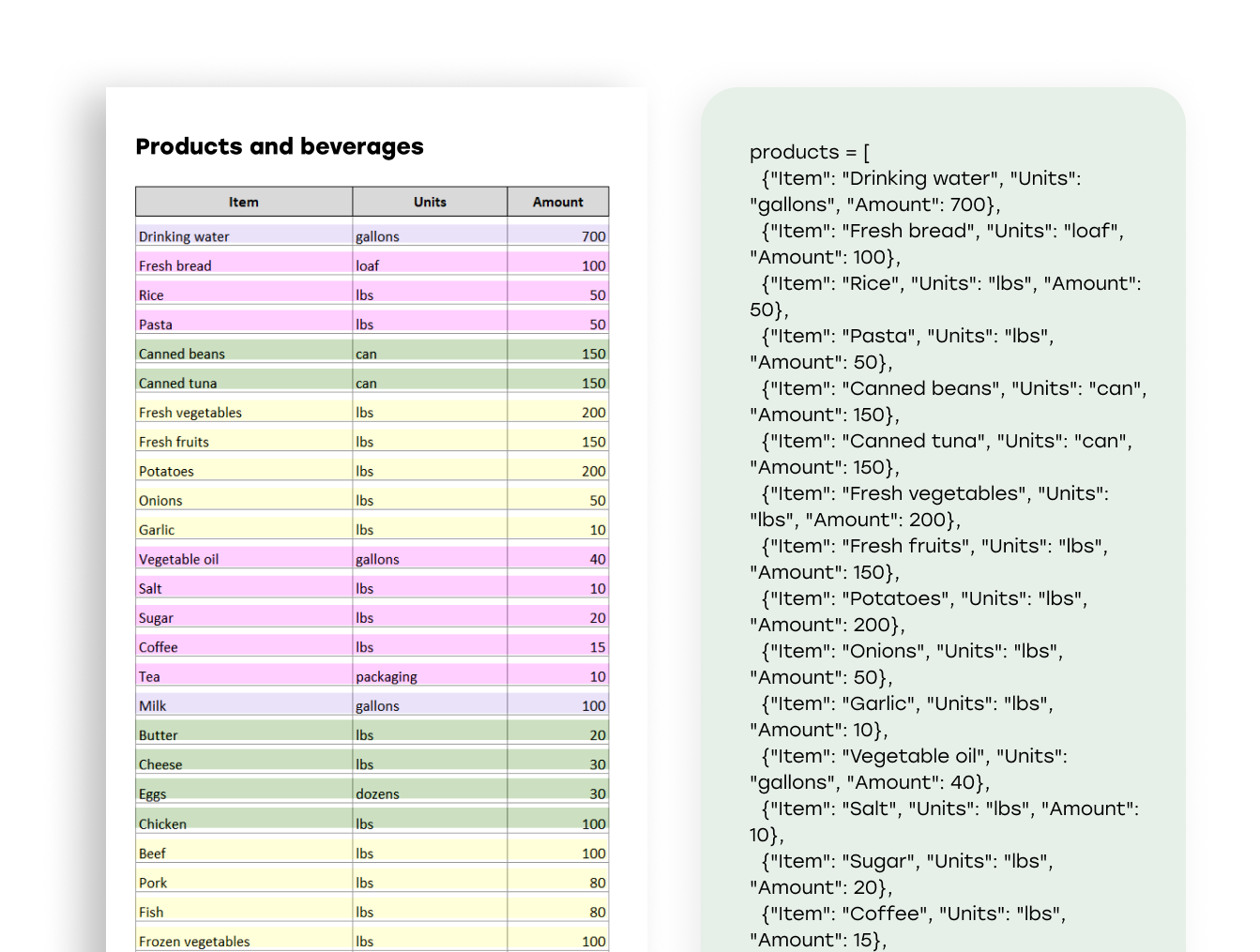
Standard parsers, OCR, normalization, and classification handle incoming files.
A hybrid approach combining vector search (FAISS, pgvector) with fuzzy text matching (cosine similarity, rapidfuzz) maps free-text descriptions onto catalogue records, drawing on IMPA/ISSA codes, historical quotations, and supplier data. Matches hold up despite spelling variations and multilingual inputs.
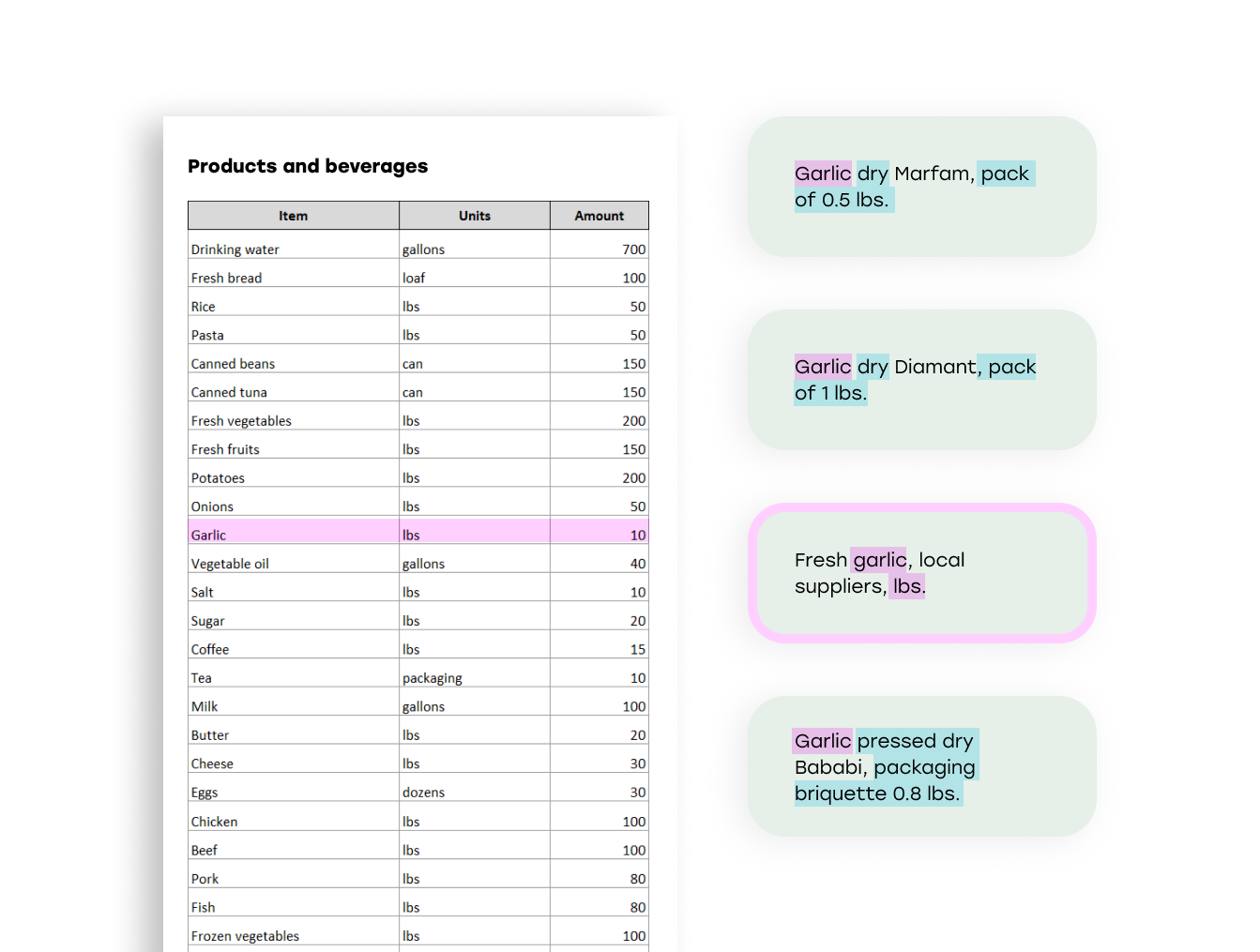
The system selects optimal suppliers and prices based on purchasing history, assigns confidence scores, and exports results to Excel for buyer review and ERP import. Confidence scoring is what routes the work: only ambiguous items reach a specialist, and they arrive with a top recommendation already attached.
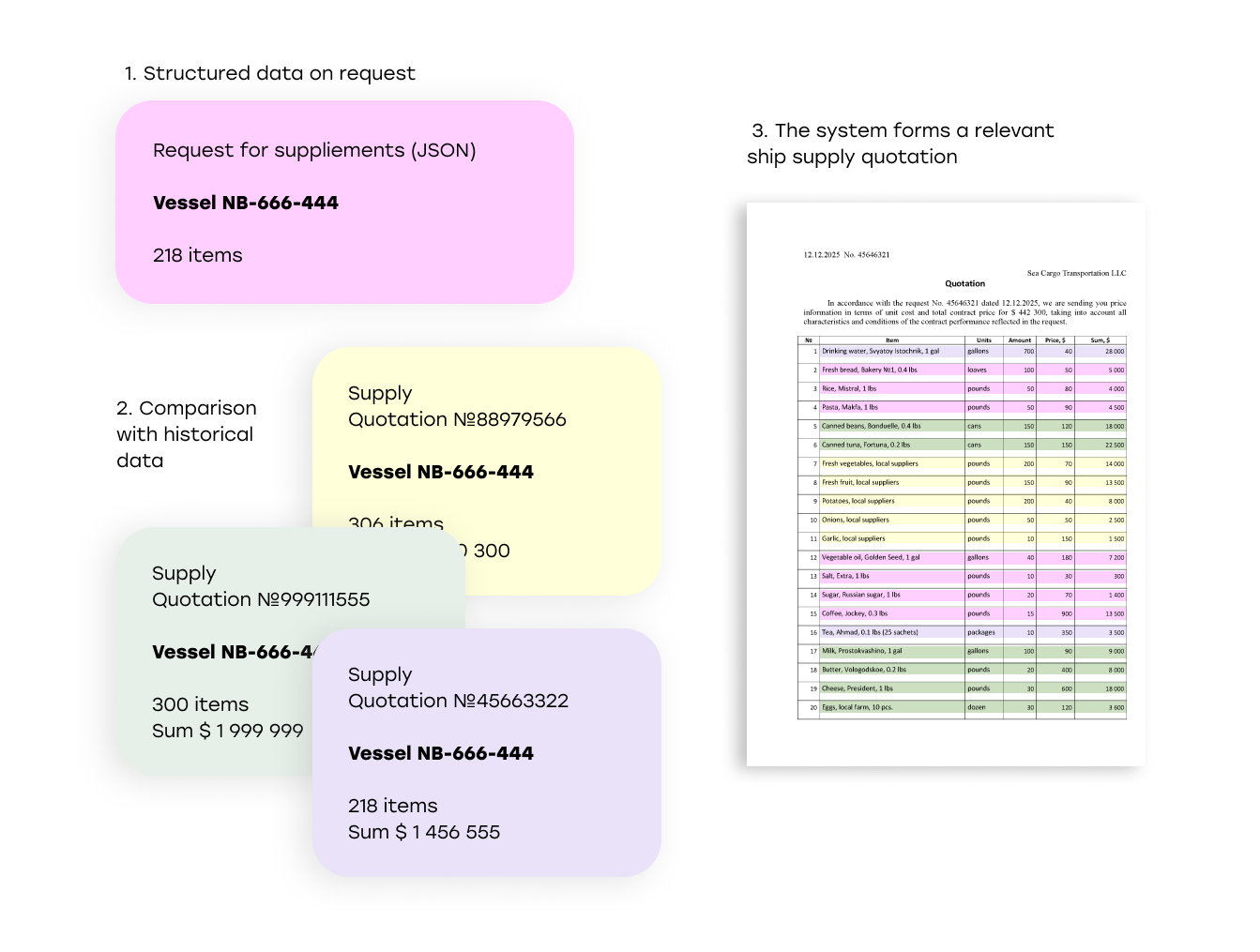
An item feedback system records every decision a specialist makes and feeds it back into the recommendation order, so recurring items and recurring customers need progressively less attention.
Docker-containerized components deployed on Azure, managed via GitLab CI, with Python, FastAPI, and PostgreSQL.
Preparing a large quotation fell from 8-16 hours of manual work to 90-120 minutes — an 85% reduction per RFQ. Automated validation decreased errors and returns. Procurement managers gained user-friendly access to the system; leadership gained visibility into quotation volume and turnaround. The platform scales to additional business areas and partners.
The peak-load bottleneck eased in particular. With extraction, matching, and pricing handled up front, a senior manager's involvement shifted from building the quotation to checking it — so the same team could carry a cluster of large RFQs concurrently instead of working through them in sequence. Capacity stopped being a function of how many experienced people were free that week, and the team now quotes roughly a fifth more RFQs per quarter with the same headcount.
A quotation is only as good as the item data behind it — and that data arrives in exactly the same condition the customer requests do.
Suppliers send catalogs and price lists on their own schedules and in their own conventions: a PDF catalogue from one, a spreadsheet export from another, a portal download with the columns rearranged since last quarter. Descriptions, pack sizes, units of measure, currencies, and article numbers rarely line up with how the same items sit in the catalogue and the ERP item master — and IMPA/ISSA codes, where a supplier provides them at all, cover only part of the range. Historically that leaves two options — retype it, or let it go stale. Most companies end up doing both: updating the fast-moving items by hand and quietly quoting the rest from prices that are months old.
This is the same task the system already performs, pointed in the other direction. Instead of matching a customer’s request line to a catalog item, it matches a supplier’s catalog line to an ERP item — messy document in, structured reconciliation out.
| Already built for quotations | What it does for catalogs |
| Parsers, OCR, classification | Reads catalogs and price lists arriving by email, SFTP, or portal download |
| Normalization | Converts units, pack sizes, currencies, and incoterms to internal conventions |
| Hybrid vector + fuzzy matching | Reconciles each catalog line against the ERP item master |
| Confidence scoring | Separates automatic updates from lines that need a buyer's eye |
| Review and ERP export | Writes prices, lead times, and new item candidates back to the ERP |
| Item feedback system | Turns each buyer decision into an alias, shrinking the next review queue |
Because those components are already in production, the incremental build is narrow. What gets added on top is the part specific to catalogs:
| Routing | Confident matches update price, availability, MOQ, and lead time directly. Uncertain matches go to a review queue with candidates ranked and the evidence shown. Lines with no counterpart are proposed as new items with attributes pre-filled and checked against existing records, so duplicate SKUs aren’t created. |
| Diffing | Each catalog is compared against the previous version from the same supplier, so a refresh surfaces price movements, discontinued articles, and changed lead times as a short exception list rather than a full re-read. |
| Provenance | Every update carries the document, page or row, timestamp, and whether a person confirmed it — so updates can be applied automatically without giving up traceability when a margin question surfaces months later. |
Both flows share one dictionary. A correction made while reviewing a supplier catalog improves matching on the next customer request, and vice versa. The system learns the company’s product vocabulary from both directions at once, instead of maintaining two sets of rules that drift apart.
The effect on the quotation flow is direct. Faster turnaround matters less if the prices being quoted are out of date; keeping the item master current is what turns a quick quote into a correct one. And the division of labour stays the same as it is today — buyers stop transcribing and start adjudicating, seeing only the lines the system was unsure about, with the existing item feedback system writing each decision back so the next catalog from that supplier arrives with a shorter queue than the last.
Do you want to know the total cost of development and realization of the project? Tell us about your requirements, our specialists will contact you as soon as possible.