n8n is often seen as a flexible workflow automation tool: an open-source way to connect APIs, sync systems, and cut manual work. But when workflows involve complex documents, large datasets, or AI-driven decisions, n8n becomes much more.
In advanced use cases, it acts as an orchestration layer for AI, coordinating language models, databases, internal services, and external tools into reliable pipelines. This is crucial for document-heavy workflows, where data is messy, naming conventions vary, and both accuracy and speed matter.
As organizations scale, processing thousands of records, enriching unstructured data, or embedding AI agents, naïve n8n setups hit limits. Bottlenecks appear, AI outputs become inconsistent, and workflows that worked at small scale start to fail.
With the right architecture, prompt design, and scaling strategies, n8n can handle sophisticated AI-driven workflows that are fast, accurate, and production-ready.
What Makes an "Advanced" n8n Use Case?
Not every n8n workflow qualifies as advanced. Connecting a few APIs or triggering notifications based on simple conditions is often enough for lightweight automation. Advanced use cases emerge when automation is pushed into domains where data is messy, decisions are probabilistic, and performance constraints are real.
Data Complexity
One defining characteristic is data complexity. Advanced n8n workflows frequently operate on unstructured or semi-structured inputs such as product catalogs, invoices, contracts, technical documentation, or supplier price lists. These inputs rarely follow a single schema and often require interpretation rather than straightforward field mapping.
Scale
Another key factor is scale. Processing a handful of records interactively is very different from ingesting thousands of items on a daily schedule. At this level, workflow design decisions — looping strategies, batching, parallel execution, and error handling — have a measurable impact on execution time and system stability.
AI-driven logic
Advanced workflows also rely on AI-driven logic, not just deterministic rules. Instead of simple if/else conditions, they incorporate large language models for classification, similarity matching, enrichment, and validation. This introduces new challenges: prompt consistency, response structure, cost control, and latency must all be managed explicitly within the workflow.
Reliability & Auditability
Finally, there is an expectation of reliability and auditability. Production-grade n8n pipelines need to handle partial failures gracefully, retry intelligently, and produce traceable outputs. When workflows influence downstream systems, like inventory updates, pricing decisions, or customer-facing data, there is little tolerance for silent errors or unpredictable behavior.
When these factors converge, n8n stops being “just” an automation tool. It becomes an AI workflow engine: one that requires deliberate architecture and an understanding of how AI systems behave at scale. This foundation is what enables the more advanced n8n use cases explored next.
Looking for AI developers?
We create AI software — and we do it well. Talk to us to get your project started today
Advanced Use Cases for n8n
Once n8n workflows move beyond simple integrations, they are often used to orchestrate AI-driven processes that would be difficult to manage in a single application or script. Below are some of the most common advanced use cases for n8n in production environments, particularly where complex documents and high data volumes are involved.
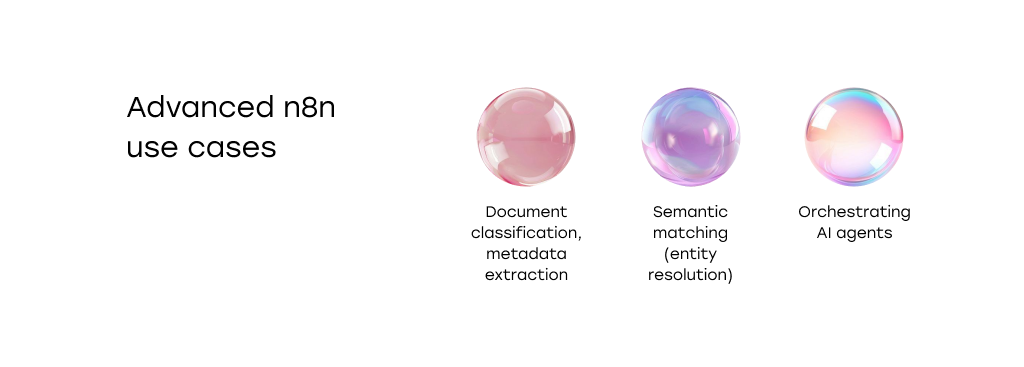
AI-Powered Document Classification and Enrichment
Many organizations process large streams of documents that must be classified, tagged, or enriched before they can be used downstream. These documents often:
- Arrive in multiple formats
- Follow inconsistent naming conventions
- Contain incomplete or ambiguous information
In advanced n8n setups, large language models are used to interpret these inputs by:
- Identifying document types
- Extracting structured metadata
- Normalizing values across sources
- Flagging unclear or conflicting information
n8n coordinates the entire flow:handling ingestion, pre-processing, AI calls, and post-processing within a single, auditable workflow.
At this level, effectiveness depends heavily on how AI steps are designed. High-performing workflows typically include:- Structured prompts instead of free-form instructions
- Well-defined output schemas
- Explicit validation steps to prevent cascading errors
Teams that treat AI calls as first-class workflow components, rather than opaque black boxes, consistently achieve higher accuracy and stability.
Semantic Matching and Entity Resolution at Scale
Entity resolution is a common challenge in advanced n8n workflows. It involves determining whether two records refer to the same real-world item despite variations in naming, formatting, or language. This problem is particularly relevant in areas like product catalogs, supplier feeds, customer databases, and inventory systems.
Moving Beyond Exact Matches
Traditional approaches often rely on exact string matches or brittle heuristics, which break down when data is inconsistent. Advanced n8n workflows instead leverage semantic matching, where AI models analyze the meaning behind entries rather than their surface-level text. This allows workflows to:
- Compare hundreds of potential candidates simultaneously
- Identify the most likely matches even with inconsistent naming conventions
n8n as the Orchestration Layer
In these setups, n8n coordinates the entire process:
- Prepare and normalize input data — ensuring records are in a consistent format before AI evaluation
- Trigger similarity searches — using semantic comparisons to generate candidate matches
- Aggregate results — rank potential matches and identify the best candidate
- Apply business rules — finalize matches and trigger downstream actions
- This orchestration-first approach provides two key benefits:
- Improved accuracy — AI-driven matching handles ambiguity more effectively than manual or rule-based methods
- Scalability — processes hundreds or thousands of records efficiently, far outperforming sequential, record-by-record comparisons
By structuring workflows this way, teams can confidently resolve entities at scale while maintaining clarity, reliability, and performance.
Building AI Agents Orchestrated by n8n
n8n is increasingly used as the control layer for AI agents. In this role, it does not replace the model or the agent logic itself. Instead, it coordinates how agents interact with tools, data sources, and downstream systems, ensuring workflows remain predictable and maintainable.
How AI Agents Work in n8n
A typical AI agent workflow orchestrated by n8n may include:
- Task ingestion: The agent receives a task or trigger from a system, file, or API call.
- Context retrieval: Relevant data is gathered and normalized for the AI model.
- AI execution: One or more models are called to analyze data, classify inputs, or generate outputs.
- Validation: Results are checked for accuracy, completeness, or compliance with expected schemas.
- Action: The agent executes downstream actions, such as updating a database, sending notifications, or triggering another workflow.
n8n provides the structural backbone around these steps, including managing retries, enforcing execution order, and integrating with external services. This orchestration-first approach ensures that AI agents are more reliable, auditable, and easier to maintain.
Benefits of the Orchestration Approach
- Responsibilities are clearly separated between orchestration, intelligence, and execution
- Workflows can evolve as requirements change without rewriting core AI logic
- Predictable execution reduces errors and operational overhead
Together, these advanced use cases illustrate how n8n supports AI-driven workflows that go far beyond basic automation. The next step is understanding how to design these systems effectively, particularly when building AI agents and integrating them with existing AI tools.
How to Build AI Agents with n8n (Without Overengineering)
Building AI agents with n8n is less about adding more AI nodes and more about designing clear responsibilities within the workflow. n8n excels at orchestration: sequencing steps, handling integrations, and enforcing control flow. Advanced teams use it to coordinate AI behavior, not to embed all intelligence into a single step.
A practical starting point is to separate decision-making from execution. The AI agent is responsible for interpreting context and producing structured outputs, while n8n manages when that agent runs, what data it receives, and how its results are applied. This separation keeps workflows easier to reason about and significantly reduces failure modes.
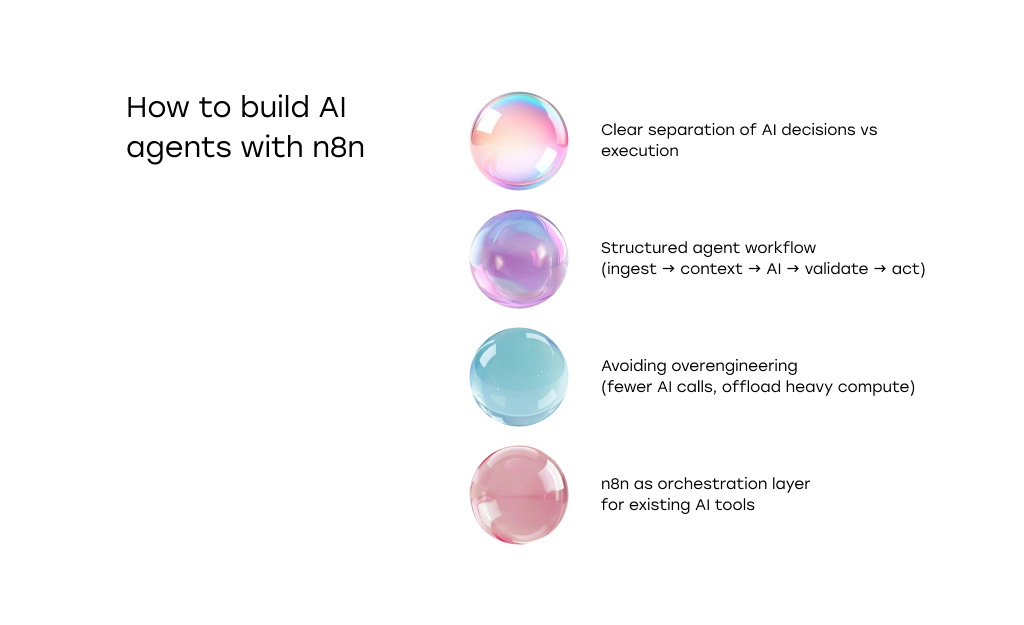
A Typical AI Agent Architecture in n8n
- Most production-ready AI agents built with n8n follow a similar pattern:
- Trigger and ingestion: A scheduled job, webhook, or file upload initiates the workflow.
- Context preparation: Relevant data is collected, normalized, and trimmed to only what the model needs.
- AI invocation: One or more LLM calls are executed with structured prompts and explicit output formats.
- Validation and control: Outputs are checked for completeness, confidence, or schema compliance.
- Action and feedback: Results are written to databases, sent to downstream systems, or used to trigger follow-up workflows.
n8n provides visibility and control at each stage, making it easier to debug agent behavior and introduce safeguards where needed.
Avoiding Common Overengineering Pitfalls
When building AI agents with n8n, even experienced teams can fall into design traps that reduce workflow efficiency and increase operational costs. Two pitfalls are particularly common.
Treating Every Task as a Separate AI Call
A frequent mistake is treating each task or step as an individual AI request. This approach often results in:
- Bloated workflows with unnecessary complexity
- Increased latency for each run
- Higher operational costs due to repeated AI calls
In most cases, related tasks can be consolidated into a single, well-structured prompt. This reduces overhead while maintaining clarity and accuracy in AI outputs.
Performing Heavy Data Operations Inside n8n
Another common issue is executing compute-intensive tasks, like large-scale similarity searches or complex comparisons, directly within n8n nodes. While n8n handles moderate data processing well, pushing heavy operations into the workflow can lead to slow execution and resource strain.
A more effective strategy is to delegate compute-heavy operations to specialized services. n8n then coordinates inputs and outputs, ensuring smooth orchestration without overloading the workflow itself.
Integrating n8n with Existing AI Tools
n8n is built to integrate seamlessly with existing AI infrastructure, whether models are hosted internally or accessed via external providers. It can handle:
- Passing structured inputs to AI models
- Managing authentication securely
- Routing outputs to the appropriate downstream systems
Incremental Introduction of AI Agents
This flexibility allows teams to introduce AI agents incrementally. Existing models, vector databases, or document processing services can be incorporated into n8n workflows without requiring a complete platform rewrite. Over time, these integrations can be:
- Refined for efficiency
- Optimized for performance
- Replaced as requirements evolve
Scaling n8n for High-Volume AI Workloads
As AI-driven workflows grow, scaling becomes a critical challenge. Many n8n pipelines perform well during initial rollout but begin to degrade as:
- Data volumes increase
- AI usage grows
- Workflow execution frequency rises
At this stage, performance issues are rarely caused by n8n itself. Instead, they usually stem from workflow design decisions.
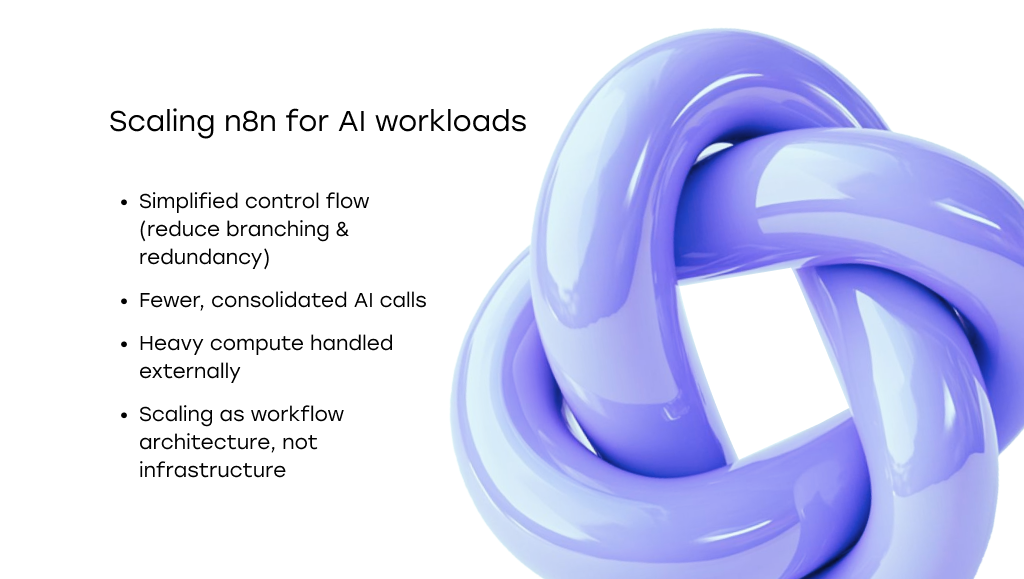
Common Bottleneck: Sequential Processing
One of the most frequent limitations is sequential processing. Executing the same steps for each record individually may work at a small scale, but it becomes prohibitively slow when processing hundreds or thousands of items per run.
Advanced workflows address this by adopting batch-oriented designs, grouping records wherever possible and reducing per-item overhead. This approach significantly improves throughput without requiring additional infrastructure.
Common Bottleneck: Excessive Branching and Redundant Logic
Another frequent issue is complex decision trees and redundant operations. Overly branched workflows can:
- Make maintenance difficult
- Increase execution time
- Introduce unnecessary complexity
Simplifying the control flow and consolidating related operations often yields immediate performance improvements, making workflows faster and easier to maintain without major infrastructure changes.
Best Practices for Scaling n8n Workflows
Effective scaling starts with workflow design:
- Batch and parallelize intentionally: Process multiple records per execution while enforcing sensible concurrency limits to avoid overwhelming downstream services.
- Minimize AI calls: Consolidate prompts and avoid repeating similar LLM requests across workflow branches.
- Externalize heavy operations: Delegate compute-intensive tasks such as similarity search or large data retrieval to purpose-built systems, and let n8n orchestrate the results.
- Design for idempotency: Ensure workflows can safely retry without duplicating side effects, especially in scheduled or long-running jobs.
These practices not only improve throughput but also make workflows more predictable and easier to operate.
Scaling Is an Architectural Concern, Not Just an Infrastructure One
While horizontal scaling, queue-based execution, and worker tuning can improve capacity, they cannot compensate for inefficient workflow logic. In many production systems, the most impactful optimizations come from refactoring pipelines: reducing unnecessary steps, rethinking data access patterns, and aligning AI usage with real business requirements.
Teams that treat scaling as an architectural discipline, rather than a last-minute fix, are able to run n8n workflows that handle large, continuously growing data volumes without sacrificing reliability or control.
Data Security and Privacy in AI-Driven n8n Workflows
When n8n orchestrates AI workflows around complex documents, data security and privacy become critical considerations. These workflows often process sensitive commercial information, proprietary documents, or customer data, making it essential to maintain strict control over where data flows and how it is handled.
Leveraging Self-Hosted Architecture
One of n8n’s key advantages in this context is its self-hosted architecture. By running n8n within an organization’s infrastructure, workflows can be designed so that raw documents and intermediate data never leave controlled environments.
This is particularly important when working with AI models, as indiscriminate data sharing can introduce compliance and confidentiality risks.
Controlling Data Flow in AI Integrations
In advanced setups, n8n acts as a gatekeeper between internal systems and external AI services:
- Inputs can be filtered, anonymized, or reduced to the minimum necessary context before being sent to a model.
- Outputs can be validated and logged before use by downstream systems.
This approach allows teams to leverage AI capabilities without exposing entire documents or datasets unnecessarily. It also simplifies enforcement of organization-specific policies around data retention, access control, and auditing.
Auditability, Logging, and Failure Handling
Production AI workflows must be observable and auditable. n8n provides detailed execution logs, making it possible to trace how a decision or classification was produced. When combined with structured AI outputs and validation steps, this creates a reliable audit trail for troubleshooting and accountability.
Equally important is failure handling. Timeouts, malformed AI responses, or upstream data issues should not result in silent errors. Well-designed n8n workflows include:
- Retries and fallback paths
- Alerting mechanisms for early detection of issues
By treating security and privacy as integral parts of workflow design, rather than afterthoughts, advanced n8n implementations can safely support AI-driven document processing at scale, even under strict compliance requirements.
Lessons from Real-World n8n AI Optimizations
In production environments, the difference between a functional n8n workflow and an effective one often becomes apparent only after the system is under real load. Workflows that appear sound in testing can struggle when they are exposed to large datasets, inconsistent inputs, and tight processing windows. Over time, certain patterns tend to repeat across AI-driven n8n projects.
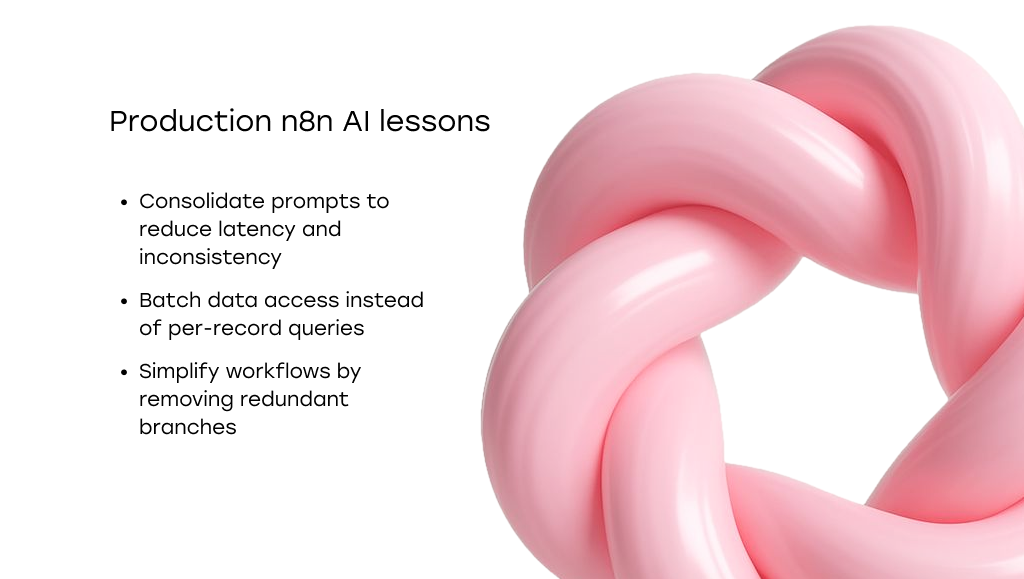
Common Issue: Prompt Sprawl
One frequent problem is prompt sprawl. As workflows evolve, AI logic is often added incrementally: one classification step here, a validation step there, each with its own prompt. While this approach may feel modular, it can result in:
- Inconsistent outputs
- Higher latency
- Unnecessary model calls
In practice, related tasks can often be merged into a single, structured prompt, producing more stable results while reducing execution time.
Common Issue: Inefficient Data Access
Another recurring bottleneck is per-record data querying. Querying databases individually for each item may work at small scale but scales poorly when workflows process thousands of records.
More effective approaches focus on bulk retrieval and semantic filtering, allowing workflows to evaluate many candidates at once instead of executing repeated lookups.
Refining Pipelines for Performance and Reliability
Optimization often begins with workflow refactoring:
- Remove unnecessary branching and redundant transformations
- Simplify overly defensive logic for clearer execution paths
AI usage is also refined. Advanced pipelines include validation steps and confidence checks rather than assuming model outputs are always correct. This reduces manual review and prevents low-quality outputs from affecting downstream systems.
Across mature implementations, improvements rarely come from a single change. They emerge from a combination of:
- Prompt engineering
- Workflow restructuring
- Architectural adjustments
Applied with an understanding of how AI behaves at scale, these refinements create workflows that are performant, reliable, and maintainable.
n8n as a Long-Term AI Automation Platform
n8n’s real strength becomes apparent when it is treated not as a collection of automation nodes, but as a strategic layer for orchestrating AI-driven systems. In advanced use cases — especially those involving complex documents, unstructured data, and high processing volumes — the difference between success and frustration is rarely the tool itself. It is the architecture, the workflow design, and the way AI is integrated into the pipeline.
When designed thoughtfully, n8n can reliably coordinate AI agents, semantic search, document processing, and downstream business systems at scale. It supports experimentation without locking teams into brittle designs, and it allows workflows to evolve as data volumes grow and requirements change. Just as importantly, it provides the visibility and control needed to operate AI systems in production environments where accuracy, performance, and trust matter.
Advanced n8n implementations share a common theme: they are built with intent. Prompts are structured, workflows are optimized for scale, and responsibilities are clearly separated between orchestration, intelligence, and execution. These decisions compound over time, turning automation into a durable competitive advantage rather than an ongoing maintenance burden.
For organizations working with complex documents and AI-heavy workflows, n8n is not just a way to connect systems; it is a foundation for long-term automation strategy. When paired with the right design principles and expertise, it enables AI-driven processes that are scalable, secure, and ready for real-world complexity.