Over the past few years, ChatGPT, Claude, Gemini, and other language models have become familiar working tools for engineers, analysts, developers, and managers. They help write code, analyze documents, find information, work with tables, and speed up many day-to-day tasks.
Against this background, companies naturally ask: if employees already use ChatGPT and know how to work with it effectively, why invest in developing AI agents?
There is no simple answer that “ChatGPT is not enough.” In some scenarios, a ready-made AI tool is indeed sufficient. Moreover, APIs, connected tools, automations, and other ChatGPT capabilities can be used to build fairly sophisticated workflows.
So the question should be framed differently: at what point do the capabilities of a ready-made AI tool become insufficient for automating a corporate process?
In this article, we will look at how using ChatGPT differs from implementing an AI agent, when an agent can actually provide additional value, and what should be considered before developing one.
ChatGPT Automates an Individual Task. An AI Agent Automates a Business Process
The difference between ChatGPT and an AI agent is not simply that one can answer questions while the other can perform actions. Modern AI tools can already connect to external services, work with files, and use additional tools.
The key difference is the level of automation.
ChatGPT can significantly speed up individual stages of a person's work. For example, when preparing a commercial proposal, a sales manager can use it to formulate text, analyze a customer's requirements, or prepare a product description.
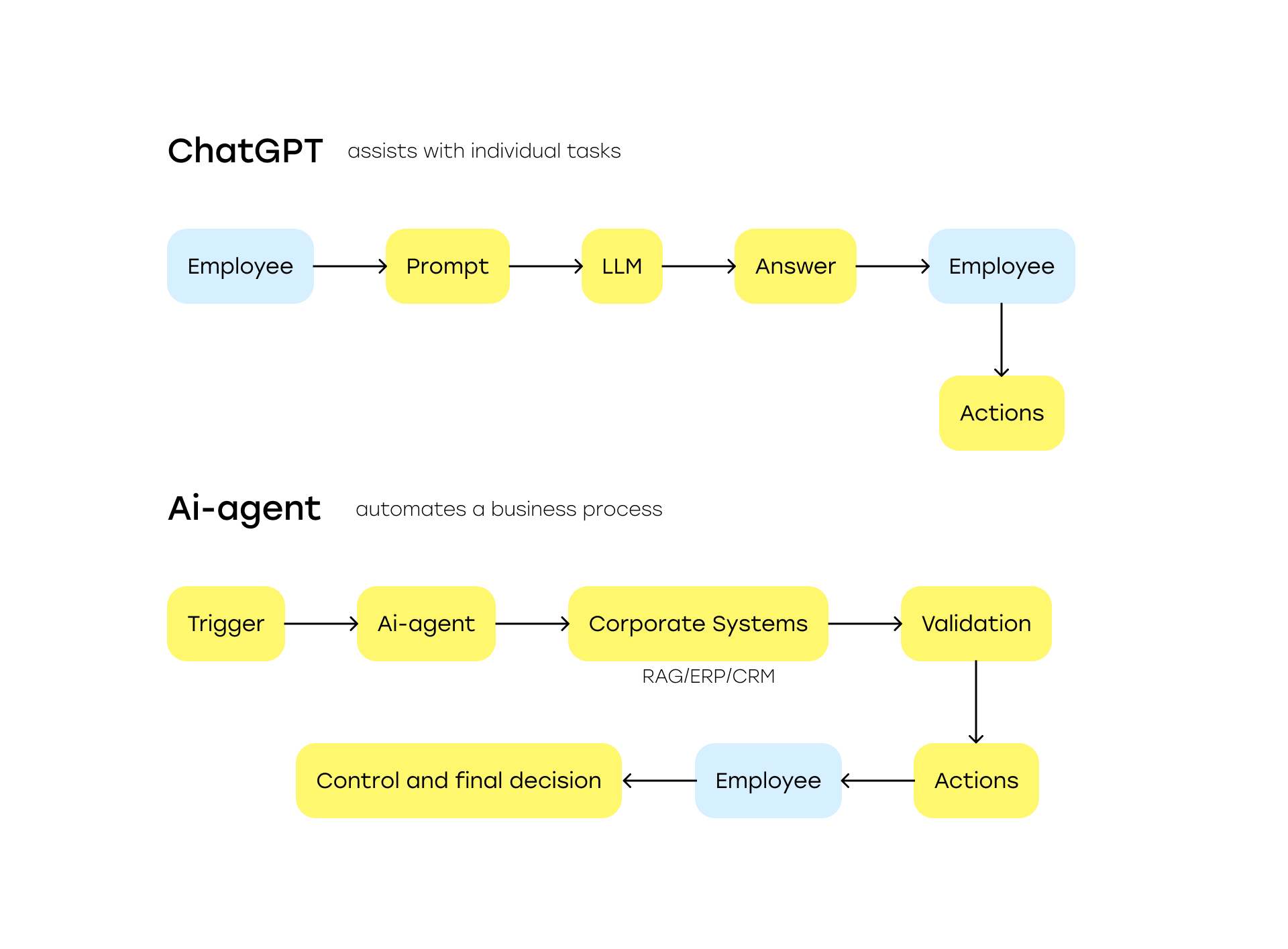
But the business process itself may still remain manual. The manager still needs to:
- find up-to-date product specifications;
- check prices and inventory;
- retrieve information from CRM or ERP;
- cross-check previous contracts and documents;
- collect the necessary materials;
- prepare the commercial proposal;
- send it for approval;
- record the result in the corporate system.
Some of these operations can also be automated using individual tools, APIs, or custom workflows built around ChatGPT. But as the number of steps and systems increases, the task becomes less about using a language model and more about developing a full-fledged software solution.
An AI agent, in this case, becomes part of the business process itself. It can receive an incoming request, determine the necessary actions, access corporate data, call the required services, process documents, generate a result, and send it to an employee for approval.
So the key question is not which system is "smarter." ChatGPT can be sufficient for an individual task, while an AI agent is needed when a sequence of actions has to be systematically automated.
Looking to automate a business process with AI?
Tell us about the process you want to automate. We can help identify which steps can be handled by an AI agent and what integrations may be required.
When ChatGPT Is Actually Enough
Not every company needs a dedicated AI agent. If an employee occasionally needs to analyze a document, prepare text, write an SQL query, understand technical documentation, or get help solving a task, a ready-made AI tool may be perfectly sufficient.
Even more complex scenarios can be built around APIs, connected tools, and automations. Therefore, developing a custom agent should not be a goal in itself.
A dedicated solution starts to make sense when the goal is not to automate the user's interaction with AI, but to automate a stable business process that needs to run regularly with minimal manual involvement.
In particular, it is worth looking at processes that:
- are launched regularly with no or minimal employee involvement;
- require several actions to be performed in sequence;
- use data from multiple corporate systems;
- process a large volume of repetitive tasks;
- have clear rules and quality criteria;
- require logging and result control;
- contain operations that can be delegated to the system, leaving employees only at control points.
For example, an employee can ask ChatGPT to check an individual invoice. But if a company needs to process hundreds of invoices every day, compare them with ERP data, identify discrepancies, save the results, and forward exceptional cases to an accountant, this is already a task for an automated process.
Thus, advanced use of ChatGPT and the development of an AI agent do not necessarily compete with each other. In many cases, ChatGPT becomes one of the components of the future system.
An AI Agent Does More Than Analyze Information: It Performs Actions
A language model itself is designed to work with information: it analyzes input data and generates an output. To turn this capability into an automated business process, a software system is built around the model that can interact with other components of the corporate infrastructure.
When it receives a task, an agent can determine which actions need to be performed and access the appropriate tools:
- retrieve information from ERP or CRM;
- find documents in the corporate knowledge base;
- use RAG to retrieve relevant context;
- extract data from PDFs, scans, or engineering drawings;
- call an external or internal API;
- create a record in a corporate system;
- generate a document or commercial proposal;
- trigger the next stage of a business process;
- hand a task over to an employee when a human decision is required.
As a result, the language model becomes just one component of the solution. The rest of the work is handled by integrations, business logic, orchestration, specialized AI modules, and control mechanisms.
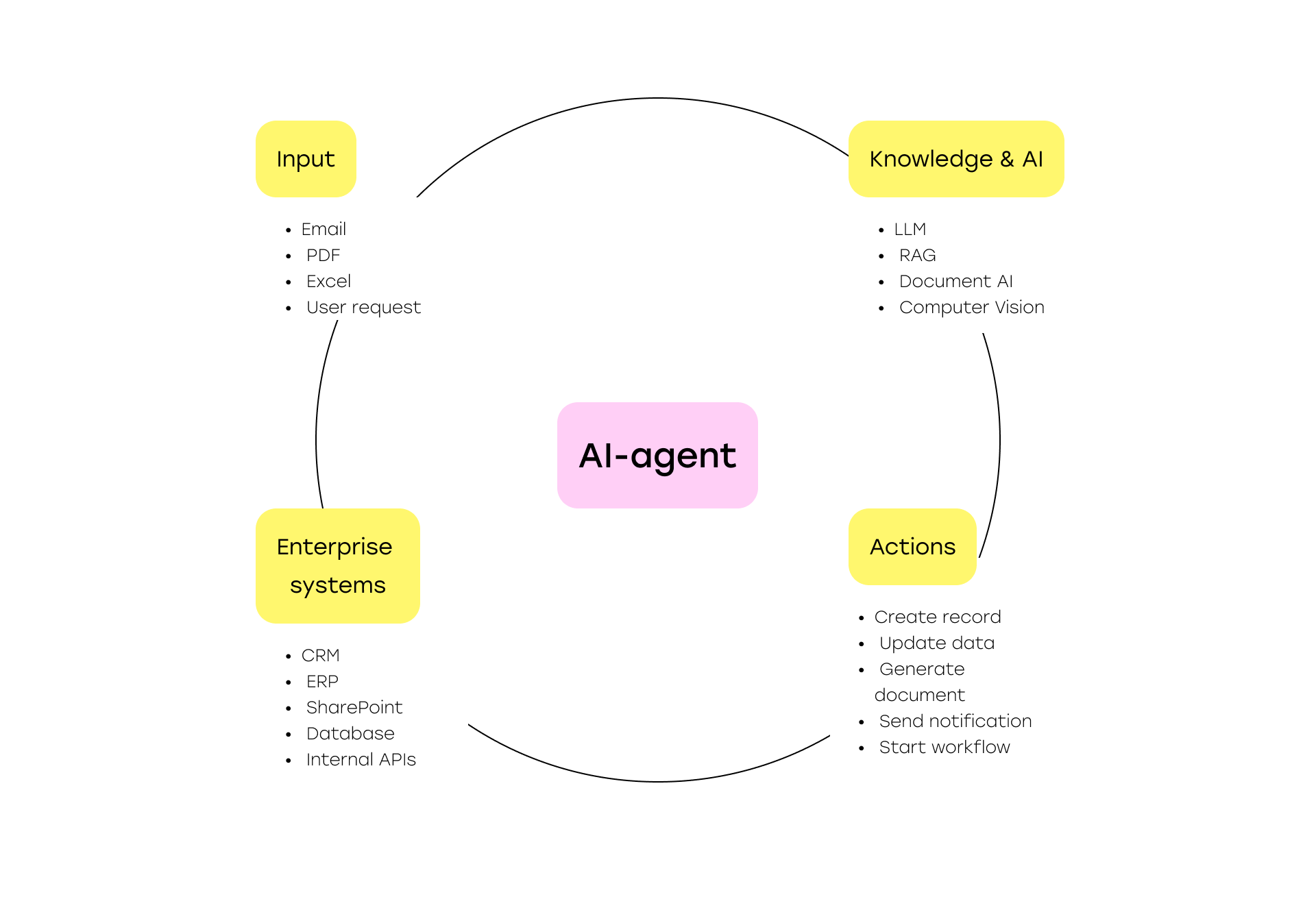
This is why a corporate AI agent is not simply "ChatGPT with more instructions." It is a software system that connects LLM capabilities with a company's data and services and uses them to execute a specific process.
Corporate AI Works with Up-to-Date Company Data
For corporate tasks, the issue is usually not a lack of general knowledge in the language model. A much more important question is: what corporate context does the model receive when performing a specific task, and where does that context come from?
Internal company information is distributed across different systems: ERP, CRM, SharePoint, file storage, knowledge bases, technical documentation, and specialized applications.
For example, preparing a commercial proposal may require up-to-date product specifications, prices from the ERP, customer information from the CRM, and technical documentation from an internal repository at the same time.
Simply passing all these documents to a single prompt is not the best way to build a corporate system. It is necessary to determine which sources should be used, which data is available to a particular user, how relevant information should be retrieved, and how its accuracy and freshness should be maintained.
This is where RAG can be used as part of an AI agent's architecture. It allows the system to retrieve relevant context from corporate sources and provide the model with the specific data required to solve the current task.
At the same time, RAG does not automatically solve every problem related to factual accuracy: retrieved data also needs to be controlled, and critical processes require additional validation and business rules.
Therefore, the advantage of a corporate agent is not that it "knows more than ChatGPT," but that it can be designed for controlled work with up-to-date corporate data and systems.
Need an AI agent that works with your corporate data?
Connect AI agents to your internal documents, knowledge bases, CRM, ERP, SharePoint, and other enterprise systems.
Why an LLM Is Not Enough for a Continuous Stream of Tasks
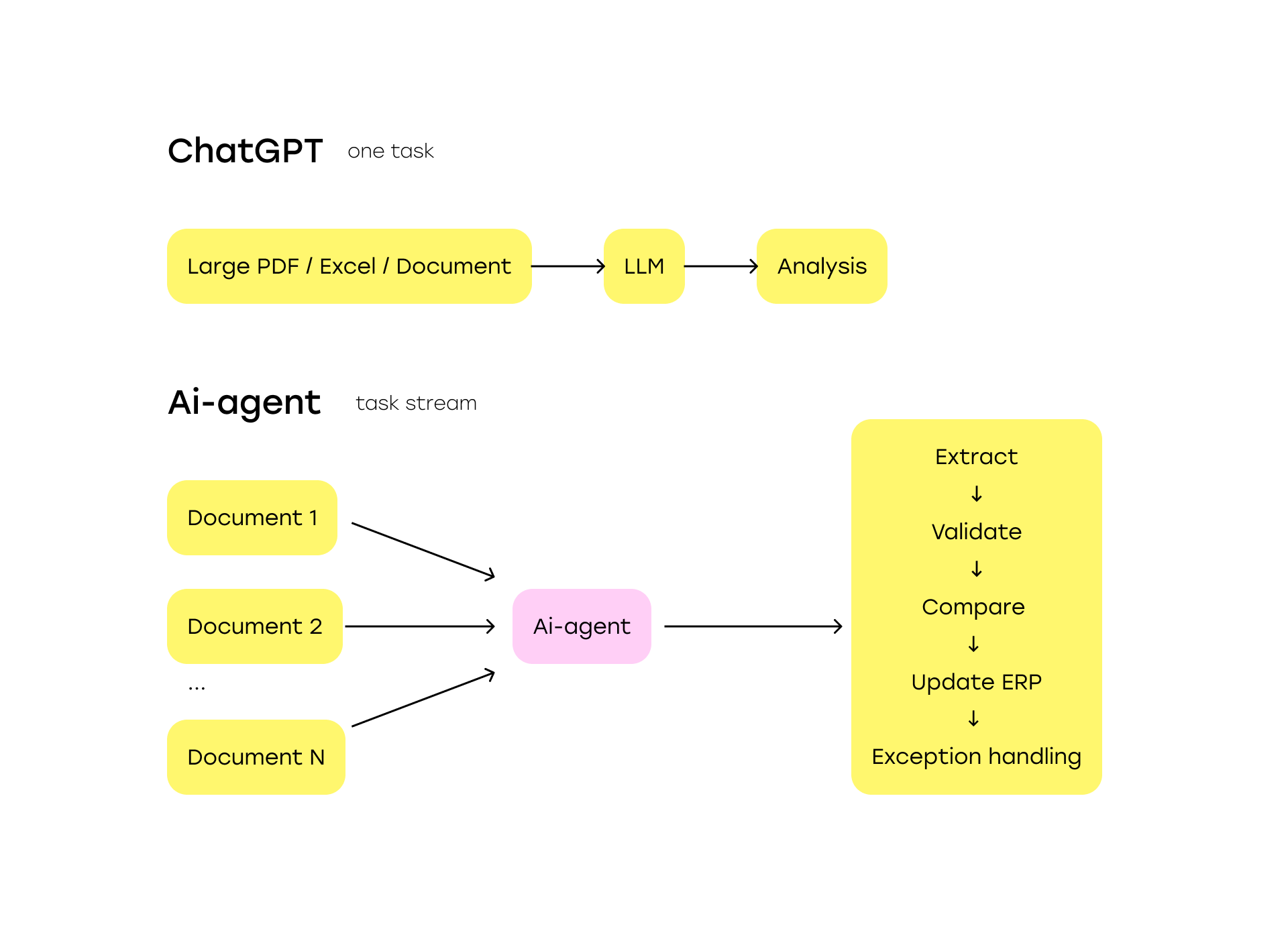
When it comes to a one-off task, the capabilities of language models are genuinely impressive. They can analyze a technical specification, work with a large document or table, and find the information needed.
But corporate processes rarely consist of a single task. They usually involve a continuous stream of repetitive operations: new invoices, customer requests, contracts, specifications, emails, or engineering documents arrive on a regular basis.
An LLM is good at analyzing a single large dataset, but by itself it is not designed to continuously process a stream of tasks.
Imagine an accounting department that receives 800 supplier invoices every day. Each individual invoice can be sent to a language model to extract details, check amounts, or compare data with an order.
But automating the process requires much more:
- retrieve new documents;
- route them to the appropriate processing scenarios;
- extract data;
- validate the results;
- compare them with information in the ERP;
- record the results;
- handle exceptions;
- forward exceptional cases to an employee;
- retry processing if a technical failure occurs.
This is the part handled by an agentic system. It turns an individual language-model call into a reproducible process that can be launched automatically and scaled as the volume of tasks grows.
When Is Developing an AI Agent Economically Justified?
Developing an AI agent requires investment. In addition to the cost of language models, companies need to account for integration development, business logic, testing, monitoring, security, and ongoing system maintenance.
Therefore, automating a process with an agent simply because it is technically possible does not necessarily make sense.
Economic value is most likely to be found in processes where:
- there is a large volume of repetitive operations;
- the process is performed regularly;
- a significant amount of working time is spent on routine tasks;
- the cost of errors can be quantified;
- there are clear criteria for the quality of the result;
- the workload may grow faster than the number of employees;
- the process is sufficiently stable and its rules do not change every week.
Economic benefits can come from several sources: reducing manual operations, speeding up the process, reducing the number of errors, and enabling the company to handle a larger volume of work without a proportional increase in headcount.
For example, if preparing one commercial proposal takes two hours and an agent reduces the amount of manual work to 15 minutes, the effect can be calculated directly based on the number of proposals and the cost of employee time. If, however, the process occurs only a few times a month and is significantly different each time, developing a dedicated agent may not be economically justified.
When calculating ROI, it is important to consider more than just the initial development cost. An agent becomes part of the corporate IT infrastructure and requires ongoing maintenance: integration updates, adaptation to new document formats, quality monitoring, and modifications when the business process itself changes.
Therefore, before development begins, it is important to assess not only technical feasibility but also the total cost of ownership over the entire lifecycle of the system.
Not sure whether AI automation will pay off?
We can analyze your business process, identify potential automation opportunities, and help estimate the expected business impact of an AI agent.
Human in the Loop: Why People Still Have a Role in an Automated Process
AI agents are often perceived as fully autonomous systems that should make all decisions independently. This approach is not always suitable for corporate processes.
Some operations have a high cost of error: approving a contract, processing a payment, sending a commercial proposal, approving engineering documentation, or handling financial documents.
In such scenarios, the goal of AI is not to replace the expert, but to take over routine preparatory work.
That is why corporate agentic systems can be built according to the Human in the Loop (HITL) principle, where a person remains part of the decision-making process.
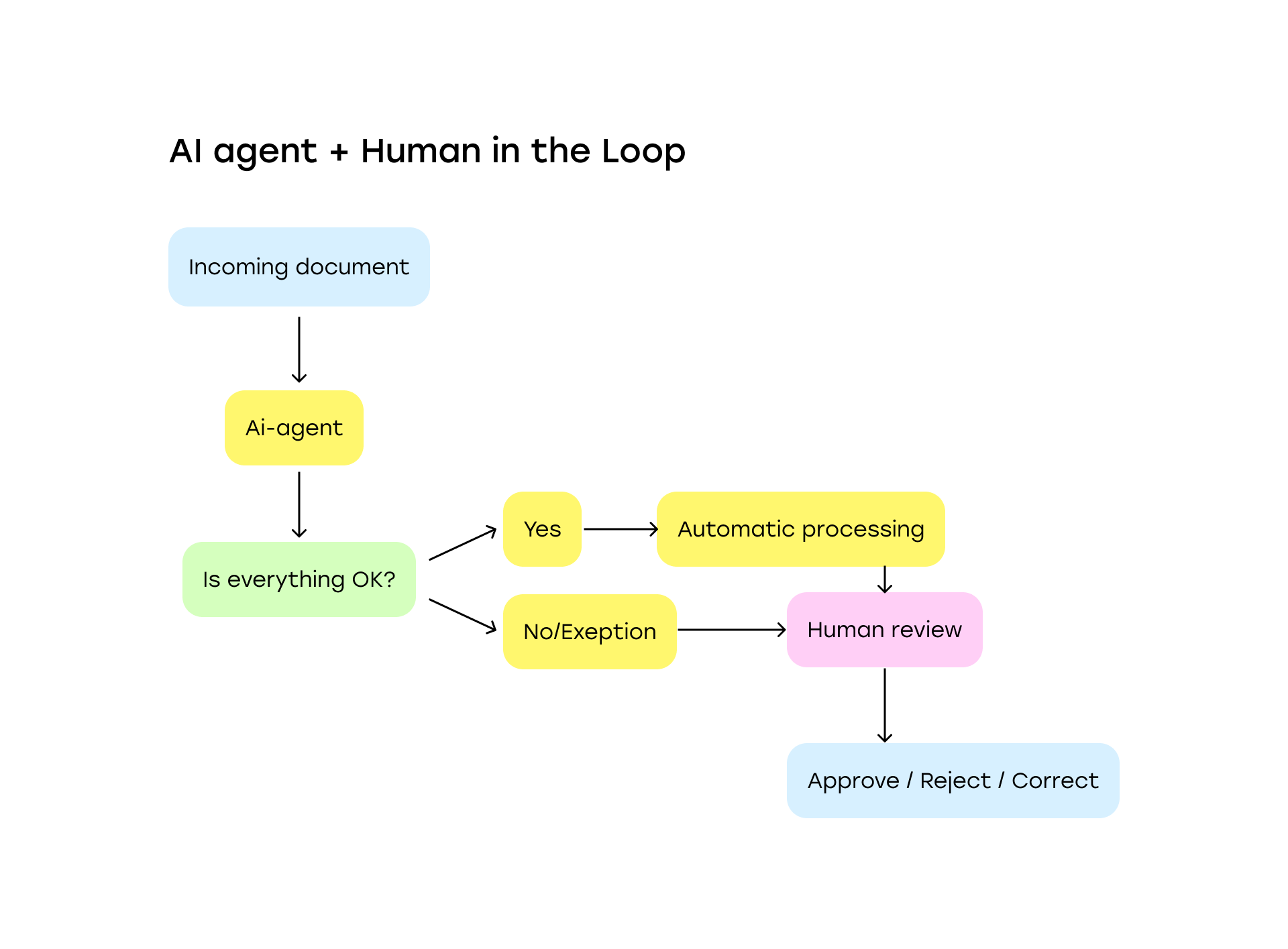
An agent can independently:
- collect data from corporate systems;
- analyze documents;
- perform the necessary checks;
- generate a result;
- identify deviations from predefined rules.
If the process follows the standard scenario, the system can complete it automatically. If a discrepancy, non-standard document, or other exception is detected, the task is handed over to an employee.
This approach makes it possible to gradually increase the level of automation while retaining human control where it is genuinely needed.
Wondering how to integrate an AI agent into your existing workflow?
Let's discuss the architecture, system integrations, and Human-in-the-Loop scenarios that fit your business process.
Security Becomes More Important as an Agent's Permissions Increase
Connecting an AI agent to corporate systems gives it capabilities that a standard chat interface does not have. An agent can not only retrieve information but also perform actions in CRM, ERP, 1C, or other systems.
Therefore, when developing a corporate agent, it is necessary to consider not only data protection but also the security of the actions it can perform.
In particular, it is important to control the agent's access rights, apply the principle of least privilege, log its actions, and require human confirmation for critical operations.
Another risk is associated with prompt injection and other attacks in which specially crafted input attempts to alter the model's behavior. If an agent has read-only access to information, the consequences of such an attack are one thing. If the agent can modify data or trigger business operations, the potential damage is significantly greater.
Therefore, the more permissions an AI agent has, the more important architectural constraints, access control, monitoring, and Human in the Loop become.
Conclusion
Advanced use of ChatGPT can indeed cover a large number of tasks, and not every company needs a dedicated AI agent. The dividing line is not between "basic ChatGPT" and a "smart agent," but between assisting an employee and automating the business process itself.
An AI agent is worth considering when a company needs to process a continuous stream of tasks, interact with corporate systems, execute a sequence of actions, and hand over only those operations to people that require their expertise or decision.
At the same time, agentic automation is not a universal solution. Before implementation, it is necessary to assess the process itself: how repetitive and stable it is, how many resources it currently requires, what errors occur, which KPIs can be improved, and what the cost of development and ongoing maintenance will be alongside the expected benefits.
It is also important to assess security requirements, access to corporate data, and the required level of system autonomy.
That is why implementing an AI agent should start not with choosing a model, but with analyzing a specific business process and the desired outcome. Once the current process metrics, potential benefits, and constraints are understood, the appropriate architecture and level of automation can be selected.
If you are considering implementing an AI agent but are not yet sure which process makes sense to automate, this analysis can be carried out together with a technical team. It can help determine the potential ROI, integration and data requirements, the necessary level of employee involvement, and whether developing a dedicated solution makes sense.
Let's Find the Right AI Automation Scenario for Your Business
Have a process that your employees handle manually on a regular basis? Tell us about it. We can help determine whether an AI agent is a good fit, what technologies and integrations are required, and where to start.